Higgsfield Alternative Without a Subscription (2026)
A Higgsfield alternative with the same Nano Banana image models, priced per image: $0.11 flat for Nano Banana Pro, no credits, no monthly plan, top up from $1.

BananaBanana is a pay-per-image Higgsfield alternative that runs the same Nano Banana image models (Nano Banana 2 and Nano Banana Pro, Google's Gemini-based generators) without a subscription. You top up a balance, each generation deducts its listed price, and whatever is left just sits there. No credits, no monthly reset, no plan tiers to decode.
The short version, if you're mid-comparison right now:
- Nano Banana Pro costs a flat $0.11 per image here (1K and 2K; 4K is $0.20). On Higgsfield the same model works out to $0.07–$0.14 per image depending on which plan you're on and whether you actually use every credit.
- Top-up bonuses stack: crypto deposits of $50+ get 5% extra balance, $100+ get 10%, and an active promo code adds another 10% on every deposit, crypto or card. Put $100 in with a code and $120 lands on the balance, which pulls the effective Pro price down to about $0.09.
- Higgsfield credits expire monthly. A BananaBanana balance doesn't expire at all.
- If you reliably generate 600+ Pro images every single month and commit to an annual plan, Higgsfield's unit price wins. Below that volume, or with uneven usage, pay-per-image wins.
- Minimum top-up is about $1 in crypto, or $20 if you'd rather pay by card, PayPal or SEPA.
The rest of this page is the math behind those four sentences, with the honest parts left in.
What does Higgsfield actually charge in 2026?
Higgsfield sells monthly credit plans. As of July 16, 2026, their pricing page lists three tiers: Starter at $19/month for 270 credits, Plus at $59/month for 1,200 credits ($47/month billed annually), and Ultra at $129/month for 3,000 credits ($99/month billed annually). Nano Banana Pro costs 2 credits per image there, a rate that has stayed constant across every lineup change I've tracked. The page quotes the same figures in euros or dollars depending on where you load it from, and prices exclude VAT until checkout.
Do the division and the plans translate to this:
| Plan | Price/mo | Credits | Nano Banana Pro images | Effective per image |
|---|---|---|---|---|
| Starter | $19 | 270 | 135 | ~$0.14 |
| Plus, monthly | $59 | 1,200 | 600 | ~$0.10 |
| Plus, annual | $47 | 1,200 | 600 | ~$0.08 |
| Ultra, monthly | $129 | 3,000 | 1,500 | ~$0.09 |
| Ultra, annual | $99 | 3,000 | 1,500 | ~$0.07 |
Two footnotes matter more than the table. First, credits are a fixed monthly amount and don't roll over; the page says so on every plan card. Skip a slow month and that month's credits are gone. Second, those per-image numbers assume you spend all 270 or 1,200 or 3,000 credits every month. Use half your Plus allowance and your real cost doubles to about $0.20 per image.
One more thing I have to flag because it genuinely complicates comparison shopping: the lineup itself moves. Two weeks before writing this, the same URL showed me different tiers with different credit counts, and a colleague loading it from another country saw a third variant. The 2-credits-per-Pro-image rate held every time, so that's the number I'd anchor on, but treat any specific plan price as a snapshot.
When is a Higgsfield plan actually worth it?
Fair is fair. At sustained high volume, subscriptions win on unit price, and I'm not going to pretend otherwise.
Against our flat $0.11 for Nano Banana Pro, the break-even sits at roughly 536 images a month on Plus monthly, or about 900 a month on Ultra annual. That's against the sticker price, though. Fund the balance with $100 top-ups and an active promo code (the bonuses stack, more on that below) and the effective rate drops to about $0.09, which pushes those lines out to roughly 640 and 1,080 images. Cross them consistently, every month, no gaps, and a fully used Higgsfield plan is cheaper per image than we are. An agency pushing 1,500 Pro renders monthly on Ultra annual pays about $0.07 apiece, which still beats us and I won't argue.
The 7-day unlimited windows are the other real perk. Ultra currently gets unlimited Nano Banana Pro and Nano Banana 2 at 2K for a week at a time. For a burst project, a catalog shoot, a campaign sprint, that's genuinely useful. The fine print: unlimited works only in their web app (not over their MCP or CLI), tops out at 2K rather than 4K, and the page itself warns that unlimited usage "may be subject to dynamic speed adjustments during high-traffic periods". Throttled unlimited is still a good deal. It's just not quite the word "unlimited" doing the work you'd hope.
So the honest decision rule: predictable 600+ Pro images a month, comfortable with an annual commitment, mostly working in their web app? Take the subscription. My experience is that very few individual users actually sit above that line month after month. Most people burst: heavy for a project, then nothing for three weeks. Bursty usage is exactly what monthly-expiring credits punish and per-image billing doesn't.
How does pay-per-image pricing compare on the same models?
The models themselves are identical, which is what makes this comparison clean. Nano Banana 2 and Nano Banana Pro are Google's models; Higgsfield and BananaBanana both run them, so a given prompt produces the same class of output on either platform. What differs is what you pay and how.
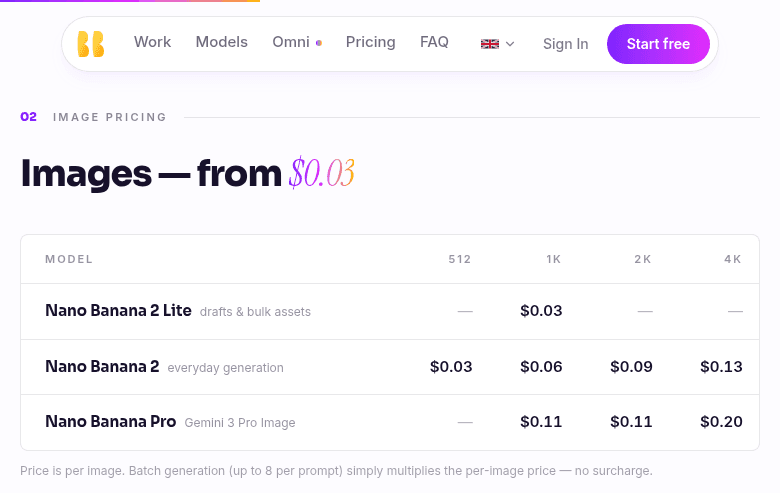
Our prices per image: Nano Banana 2 Lite at $0.03 (1K only), Nano Banana 2 from $0.03 at 512px to $0.13 at 4K, and Nano Banana Pro at $0.11 flat for 1K and 2K, $0.20 at 4K. Video is per clip on the same balance: from $0.10 for a 4-second silent 720p clip on Veo 3.1 Lite up to $6.00 for the priciest clip on the platform (Wan 3.0 at 30 seconds, 1080p).
A $10 top-up therefore buys about 90 Nano Banana Pro images. On Higgsfield, $10 doesn't buy anything, because the smallest door in is the $19 Starter plan, and that only becomes competitive if you use most of its 135-image allowance before the month flips.
Bigger crypto top-ups tilt the math further. Deposits of $50 or more earn a 5% balance bonus and $100 or more earns 10%, and an active promo code adds another 10% of the deposit on top regardless of payment method; both bonuses are calculated from the same base amount and simply added together. So $100 with a code credits $120 to the balance, which works out to about 1,090 Pro images per hundred dollars, roughly $0.09 apiece. That's not a discount you have to re-earn every month. It's just more balance, and it sits there as long as the rest does.
Where Higgsfield's math genuinely beats ours is the fully-used annual Ultra at ~$0.07. Where ours beats theirs is everywhere volume is uneven: no expiry, no minimum month, and drafts don't have to burn Pro prices. A workflow I'd actually recommend: iterate at $0.03 on the cheap models, then pay $0.11 only for finals. Per-image billing makes that split natural; a credit allowance makes everything feel free until it suddenly isn't. We wrote up the broader subscription-versus-balance argument in the no-subscription guide if you want the long form.
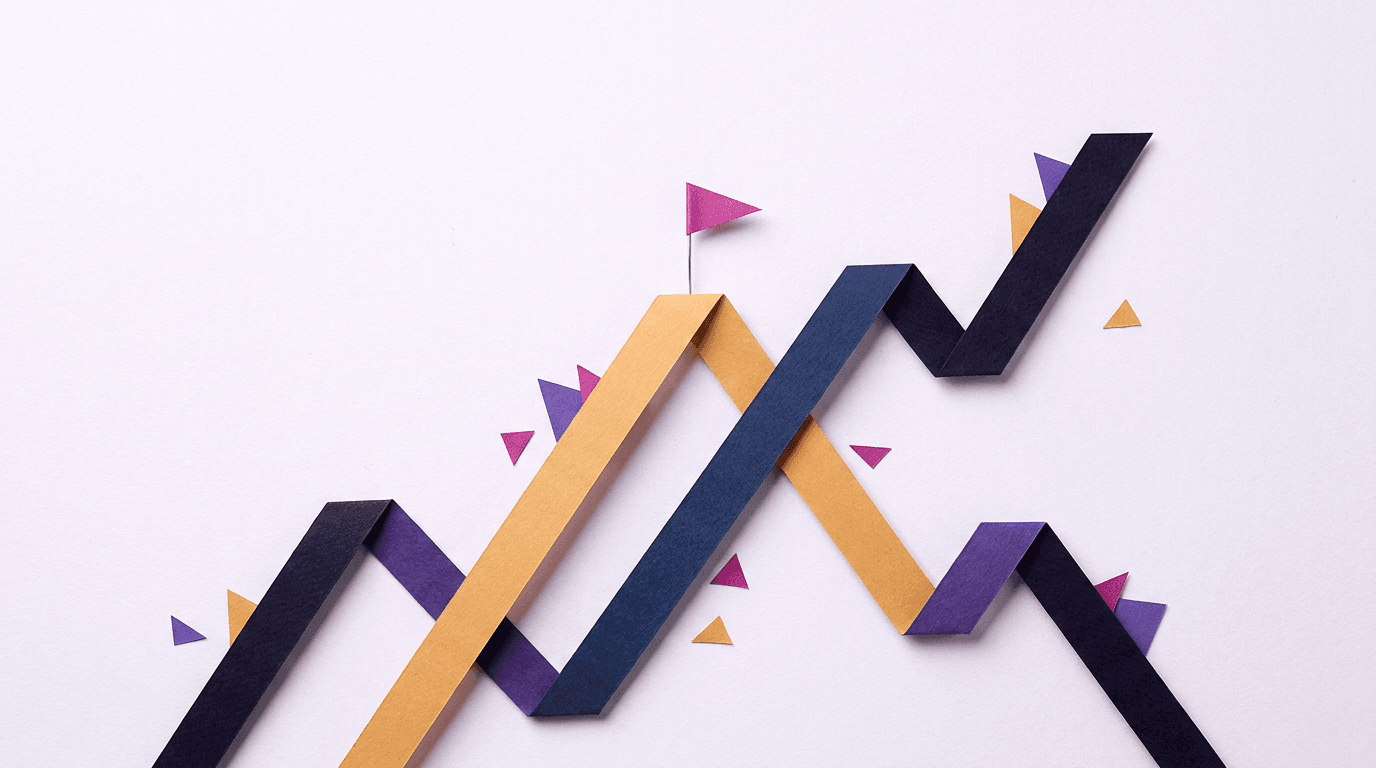
Every illustration in this post, by the way, was generated with Nano Banana Pro on our own pipeline at that $0.11 rate; the one above came from a prompt describing a paper-craft mountain chart with a flag at the crossing point. That's the model you'd be using, doing editorial work, first take.
What do you give up by switching?
A real alternatives page owes you this section, so here's what Higgsfield has that we don't.
Model breadth, mainly. Higgsfield aggregates third-party video models (Kling and Seedance lines, among others) plus their own character tools, and wraps them in studio products: a cinema studio, marketing templates, a canvas editor, plugins. If your workflow depends on one of those specific models or on template-driven video production, we're not a replacement. BananaBanana runs a narrower roster instead: Nano Banana for images, Veo 3.1 and Gemini Omni Flash for video, plus a handful of other models added since — nothing like Higgsfield's aggregation. Narrower, cheaper to operate, faster to update when a model provider ships something new.
You also give up the unlimited windows. There is no all-you-can-eat mode here; every image has a price tag. If throttled 2K unlimited weeks are the feature you'd actually exploit, that's a genuine loss.
What you don't give up: the image models themselves, prompt compatibility (same models, same prompting habits, your saved prompts move over unchanged), commercial use, or API access. On that last one, both platforms now expose MCP endpoints, but Higgsfield's fine print excludes unlimited generation from MCP and CLI use, so their agent story is still credit-metered under a subscription. Ours bills the same per-image prices from the same balance with no plan gate.

How do you move a workflow over in 10 minutes?
The actual migration is short because there's nothing to migrate except habits.
- Register with an email at bananabanana.pro. You get $0.20 of starting balance, enough for six Lite test images before paying anything.
- Top up. Crypto is the native path: USDT on TON or Solana from about $1, plus BTC, ETH and 20-odd other coins. Deposits of $50+ come with a 5% bonus, $100+ with 10%. No card on file, no renewal to remember. If you've never touched a wallet there's a real 15-minute learning curve the first time, which I'd count as the main switching cost. No crypto at all? Card, PayPal and SEPA work on the site too, from $20 a payment.
- Re-run your prompts. Nano Banana prompts behave the same because the model is the same. Pick the resolution per image instead of per plan: drafts at 1K, finals at 2K or 4K.
- Optional: wire up the API. Generate a key in your profile and any MCP-capable client (Claude Code, Cursor, VS Code and friends) can generate images and video against your balance.
Failed generations refund automatically, which matters more than it sounds when you're batch-testing prompts. And if a promo code came your way, activating it adds 10% to every deposit rather than just the first one, stacking with the size bonuses above.
The pricing page has the full per-model price grid if you want to sanity-check the numbers in this post against the live ones.
FAQ
Does a BananaBanana balance expire like Higgsfield credits?
No. Balance is prepaid USD that stays until you spend it. There's no monthly cycle, so there's nothing to reset. Higgsfield's plan cards state a fixed monthly credit amount, and unused credits don't carry over.
Are the Nano Banana models really identical on both platforms?
Yes, both platforms run Google's Nano Banana 2 and Nano Banana Pro. Output quality for a given prompt is the same class. Differences are around the model: pricing structure, resolution caps (their unlimited mode is limited to 2K; our Pro goes to 4K at $0.20), and how the API access is billed.
Can I pay without crypto?
Yes. The site takes cards, PayPal and SEPA through PayPal Checkout, from $20 a payment, and the card details are typed into PayPal's window rather than ours. Crypto stays the cheaper way in, from about $1, and the crypto payment guide walks through a first deposit step by step.
What happens when a generation fails?
The charge is refunded to your balance automatically. You pay for delivered images, not attempts. Content-filter blocks work the same way.
Do top-up bonuses and promo codes stack?
Yes, on crypto top-ups. The deposit-size bonus (5% on $50+, 10% on $100+) applies to crypto deposits only, while the promo code bonus (10%) applies to any deposit, crypto or card; the two are each calculated from the deposit amount and added together, so a $100 crypto top-up with an active code credits $120. Bonus balance is regular balance: it never expires and spends on any model.
I generate thousands of images a month. Should I even switch?
Probably not, honestly. At a steady 1,500+ Pro images every month, Higgsfield's annual Ultra beats our flat rate on unit price, and the unlimited weeks stack on top. Pay-per-image is built for everyone below that line, which is most people.