Pay-Per-Use AI Image Generator: Cost Per Image in 2026
What a pay-per-use AI image generator costs: $0.03 to $0.20 per image, what $5 or $20 buys on each model, effective rates after bonuses, when it loses.

A pay-per-use AI image generator is an image tool that charges a fixed price for each picture it renders, deducted from a prepaid balance, with no monthly plan and no quota that resets. BananaBanana works that way across its whole catalog: a draft on Nano Banana 2 Lite costs $0.03, a final on Nano Banana Pro costs $0.11 at 1K or 2K, a 4K render costs $0.20, and whatever you loaded last spring is still on the account today. This page is the price sheet with the arithmetic already done: what one image costs on each model, what $5, $20 and $100 buy, and the volume at which paying per image stops being the cheap option.
Quick answer:
- Per image: $0.03 (Nano Banana 2 Lite, or Nano Banana 2 at 512px) up to $0.20 (Nano Banana Pro at 4K). GPT Image 2.5 starts at $0.05, Qwen Image 3.0 Pro at $0.04.
- $5 buys about 166 Lite drafts, 45 Pro finals at 2K, or 25 Pro renders at 4K.
- Effective price after top-up bonuses lands near $0.09 per Pro image (math below).
- Video comes off the same balance: silent clips from $0.10, clips with sound from $0.18.
- The catch: at a steady 900 to 1,000 top-tier images every single month, a flat subscription can undercut these numbers.
What does pay per use cost per image?
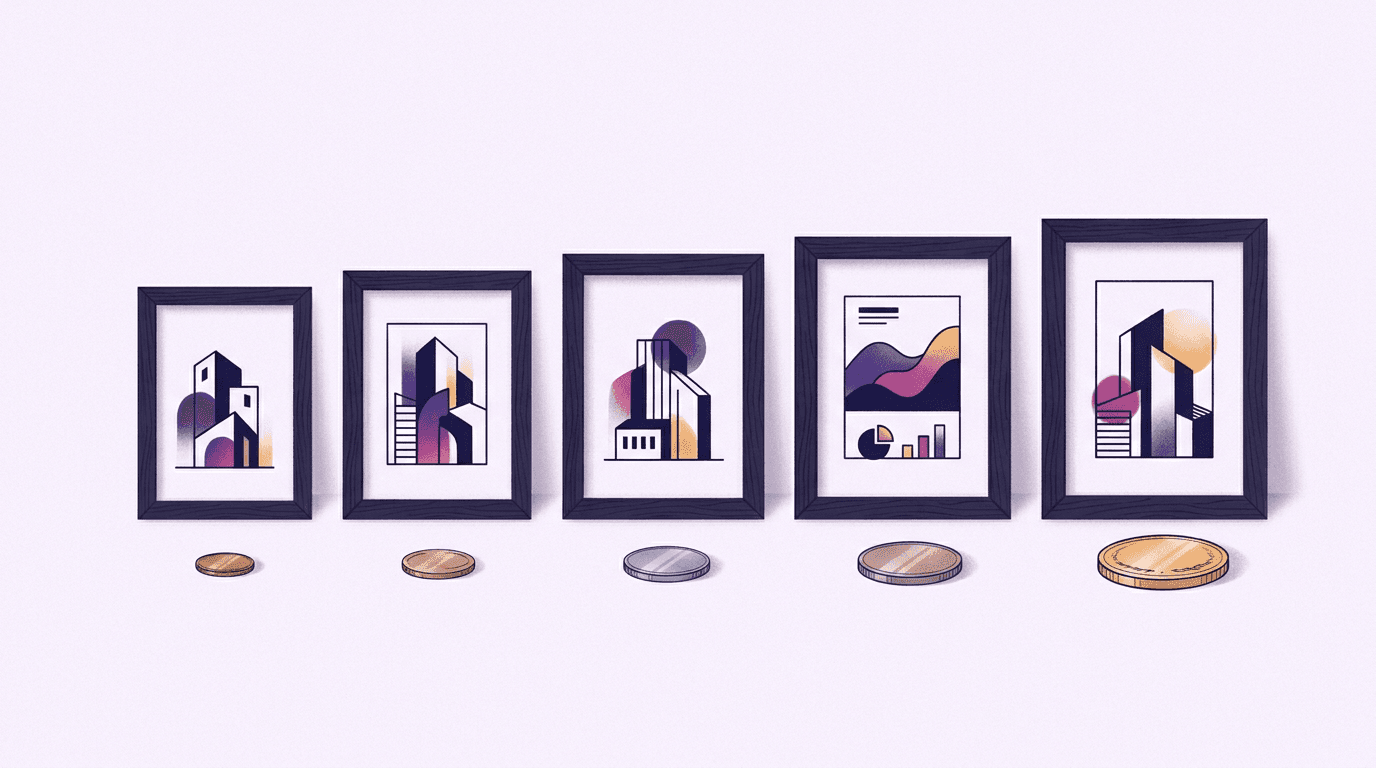
Every model on the platform has one price per resolution, and that price is printed on the Generate button before you click. These are the September 2026 numbers from the pricing page:
| Model | 512px | 1K | 2K | 4K |
|---|---|---|---|---|
| Nano Banana 2 Lite | — | $0.03 | — | — |
| Nano Banana 2 | $0.03 | $0.06 | $0.09 | $0.13 |
| Nano Banana Pro | — | $0.11 | $0.11 | $0.20 |
| GPT Image 2.5 (Flare or Sunburst) | — | $0.05 | $0.11 | $0.18 |
| Qwen Image 3.0 Pro | — | $0.04 | $0.08 | — |
Two things in that table are worth a second look. Nano Banana Pro costs the same at 1K and 2K, so there's no reason to ever pick 1K on Pro; take the 2K file and downscale if you need to. And 4K is a separate decision, not a default: $0.20 is nearly double, and unless the image is going to print or you plan to crop hard, 2K is what most people should ship.
The other half of the price is what happens when a render fails. Generative models fail more often than anyone advertises, and on a per-image system that matters: here the full price returns to the balance automatically, and a partial block by the safety filter refunds the blocked share. You pay for files you actually received. Nothing else.
What do $5, $20 and $100 actually buy?
Here's the same table turned around, because "how many images is that" is the question people actually ask:
| Balance | Lite drafts ($0.03) | Pro finals, 2K ($0.11) | Pro 4K ($0.20) | Veo 3.1 Lite clips, 4 s silent ($0.10) |
|---|---|---|---|---|
| $1 | 33 | 9 | 5 | 10 |
| $5 | 166 | 45 | 25 | 50 |
| $20 | 666 | 181 | 100 | 200 |
| $100 | 3,333 | 909 | 500 | 1,000 |
A few practical notes on the left column. $1 is the crypto minimum (USDT on TON or DAI; most other coins start at $1 to $3). Card, PayPal and SEPA start at $20. A new account also gets $0.20 on signup, which is six Lite images, enough to check output quality before you put money in.
What this table doesn't show is how people actually spend. In my experience the cheap model does most of the work. Say a product listing needs six hero images. You'd typically run 24 drafts on Lite to settle the composition ($0.72), then render the six keepers on Pro at 2K ($0.66). Total: $1.38 for a finished set. If you'd done all thirty on Pro, it'd be $3.30, and the drafts would look better than they needed to.
That draft-cheap, finish-expensive habit is the single biggest lever on your per-image cost, bigger than any bonus. It also happens to be the opposite of what "unlimited relaxed mode" plans train you to do.
How do top-up bonuses change the effective price?
Sticker prices are the whole story only if you top up $10 at a time. Two bonuses sit on top of larger deposits, and they stack:
- Size bonus (crypto deposits): 5% extra balance on $50 or more, 10% on $100 or more.
- Promo code: an active code adds 10% of the deposit amount on every top-up, not just the first. Both bonuses are calculated from the same base, so they add rather than compound.
A $100 crypto deposit with a promo code active credits $120. At that point a Nano Banana Pro image at 2K costs $100 ÷ 1,090 ≈ $0.092, and a Lite draft about $0.025. Without a code, $100 credits $110 and Pro works out to $0.10 flat. Even a $50 deposit with a code gets $57.50 of balance.
The honest limit: the size bonus is for crypto only. If you pay by card or PayPal, the sticker price is your price, though a promo code still applies. So the "effective $0.09" figure belongs to people who top up $100+ in stablecoins, which in practice is the heavier users, the ones for whom a cent per image starts to matter.
Balances don't expire, and the bonus credit doesn't either. A $120 balance loaded in September is still $120 in March if you took a break.
Can an app or an AI agent pay per image too?
Yes, and at the same prices. This is the part that makes per-image billing more than a consumer convenience.
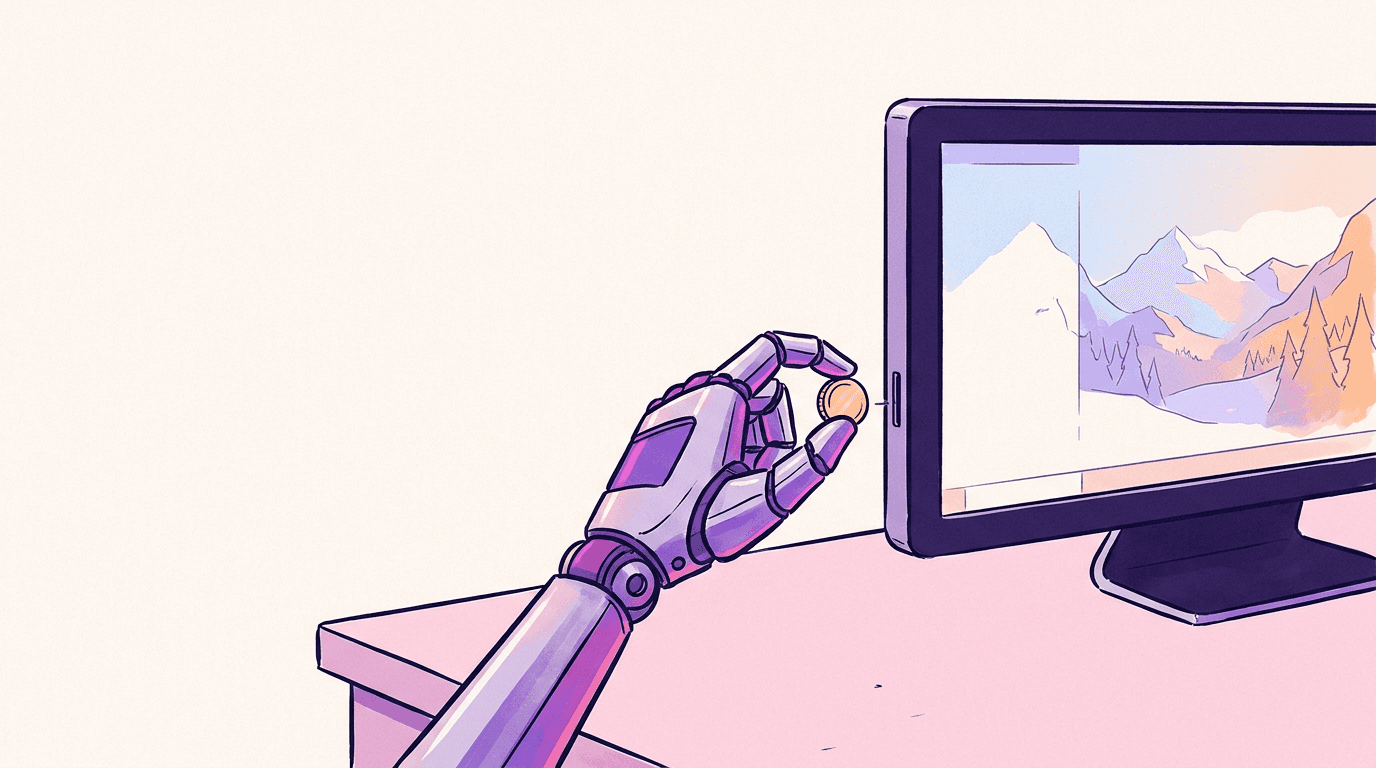
The MCP server exposes the same models to Claude, Cursor, Gemini CLI and other MCP clients. You connect with OAuth or an API key, the client calls a tool such as generate_image with a model and resolution, and the exact same $0.03 to $0.20 comes off the same balance. Video works the same way. The quote a tool returns before the job starts is the amount that gets charged; we keep those two numbers identical to the cent on purpose, because an agent can't eyeball a bill.
For fully autonomous agents there's a second route: an x402 endpoint where a program pays per call in USDC without having an account at all. No signup, no balance, one payment per image. It's niche today, but if you're building something that renders images on a schedule, per-call pricing is the only model that doesn't force you to babysit a subscription seat.
Compare that with plan-based tools, where API access is often a separate, pricier tier, or restricted to the web app entirely. Here the API isn't a tier. It's the same price sheet with a different front door.
When does pay per use lose?
It's not always the cheaper option, and pretending otherwise would be a bad look on a pricing article.
Heavy, steady volume. Subscription tools sell credit bundles, and at the top tiers a fully used month can push a top-model image under $0.10. Our rough break-even against a well-used top plan sits around 900 to 1,000 Nano Banana Pro images a month at sticker price, closer to 1,100 with bonuses. If you reliably clear that every month, a plan probably wins on unit price, and I'd say so to your face. We ran the full comparison against one subscription competitor, tier by tier, in the no-subscription breakdown.
Two images a day, forever. Freemium tools hand out a daily allowance. If a couple of casual images a day is your entire usage and a watermark doesn't bother you, zero dollars beats three cents. There's no daily free allowance here, only the one-time $0.20.
Brute-force prompting. Some people work by generating forty variations and picking one. On a per-image system that's $1.20 on Lite (fine) or $4.40 on Pro (not fine). Pay per use rewards a bit of intent per prompt, and if that's not how you like to work, a flat plan removes the friction.
The reverse cases are the majority, though: bursty usage, one-off projects, agents, and anyone who's paid for a month they didn't use. For those, per-image pricing isn't a discount. It's just paying for what you got.
FAQ
How much does a pay-per-use AI image generator cost per image?
On BananaBanana, between $0.03 and $0.20 depending on the model and resolution: $0.03 on Nano Banana 2 Lite, $0.11 for Nano Banana Pro at 1K or 2K, $0.20 for Pro at 4K, and $0.05 to $0.18 for GPT Image 2.5. Failed generations are refunded, so the price applies only to images you receive.
Is pay per use cheaper than an AI image subscription?
Below roughly 900 top-tier images a month, yes, and by a wide margin at low volume: 20 Pro images cost $2.20 instead of a $10 to $20 plan. Above about 1,000 images every month at steady volume, a fully used top-tier subscription can be cheaper per image.
Do the credits expire?
No. The balance is a USD amount on the account and stays there until it's spent. There's no monthly reset, no expiry date on bonus credit, and nothing renews.
What's the smallest amount I can pay?
$1 in crypto (USDT on TON or DAI; $1 to $3 for most other coins), or $20 by card, PayPal or SEPA. Before paying anything, the $0.20 signup balance covers six Lite images.
Can I pay per image through an API?
Yes. The MCP server charges the same per-image prices to Claude, Cursor, Gemini CLI and any other MCP client, and an x402 endpoint lets an agent pay per call in USDC with no account.